

Residential AC Specialists · Columbus, GA
Air Conditioner Repair Columbus GA
Need help with a broken or struggling home AC system? Connect with local residential air conditioning service providers serving Columbus, GA for troubleshooting, repairs, cooling problems, and emergency AC needs.
- Residential AC Service
- Columbus, GA Area
- 24/7 Emergency Availability*
- Local Service Connections
*Service availability depends on provider participation, location, technician availability, current demand, and appointment capacity.
Start here
What Is Your AC Doing?
Pick the symptom that matches what you are seeing at home. Each one explains the likely causes, what you can safely check yourself, and when the problem is urgent.
Residential services
Home Air Conditioning Services in Columbus
Residential cooling only — split systems, heat pumps, air handlers and the thermostats and drain lines that keep them running.
AC Repair
Diagnosis and repair help for home cooling systems that are underperforming, short cycling, or shut down entirely.
Read moreEmergency AC Repair
After-hours and overnight help when a home cooling system fails during a Georgia heat stretch.
Read moreAC Not Cooling
The system runs, air moves, but the house never gets to setpoint. Here is how that gets narrowed down.
Read moreThermostat Repair
Blank screens, wrong readings, short cycling, and systems that ignore the schedule.
Read moreAC Maintenance
Seasonal service that keeps airflow, drainage, and electrical components ahead of failure.
Read moreAC Replacement
How to weigh a major repair against replacing an aging home cooling system.
Read moreHeat Pump Repair
Cooling and heating faults specific to residential heat pump systems.
Read moreAC Drain Line Repair
Clogged condensate lines, overflowing pans, and float switches shutting systems down.
Read moreBuilt for this climate
AC Repair Built Around Columbus, Georgia Homes
Columbus sits along the Chattahoochee at the Fall Line, and the cooling season here is long and genuinely demanding. Systems commonly run from April into October, often for twelve or more hours a day through July and August. That run time is the single biggest reason local repair patterns look different than they do further north.
High dew points mean a residential system removes gallons of water from indoor air every day. That condensate has to leave through a narrow drain line, and in warm attics those lines grow algae quickly — which is why clogged drains and tripped float switches are among the most common midsummer calls in Muscogee County.
Outdoors, spring pollen and grass clippings mat condenser coils within weeks, raising operating pressures and quietly stealing capacity before anyone notices. Heat pumps dominate the Southeast, so changeover and defrost faults show up here in ways they simply do not in furnace-and-AC markets.
The housing stock spans both ends: older Midtown and Wynnton homes with retrofitted duct and limited return air, and newer North Columbus, Midland and Upatoi subdivisions with attic air handlers and tight envelopes where humidity control matters more than raw capacity. Summer thunderstorms add one more variable, with power blinks that damage control boards and capacitors on otherwise healthy equipment.

After hours
24/7 Emergency AC Service Availability
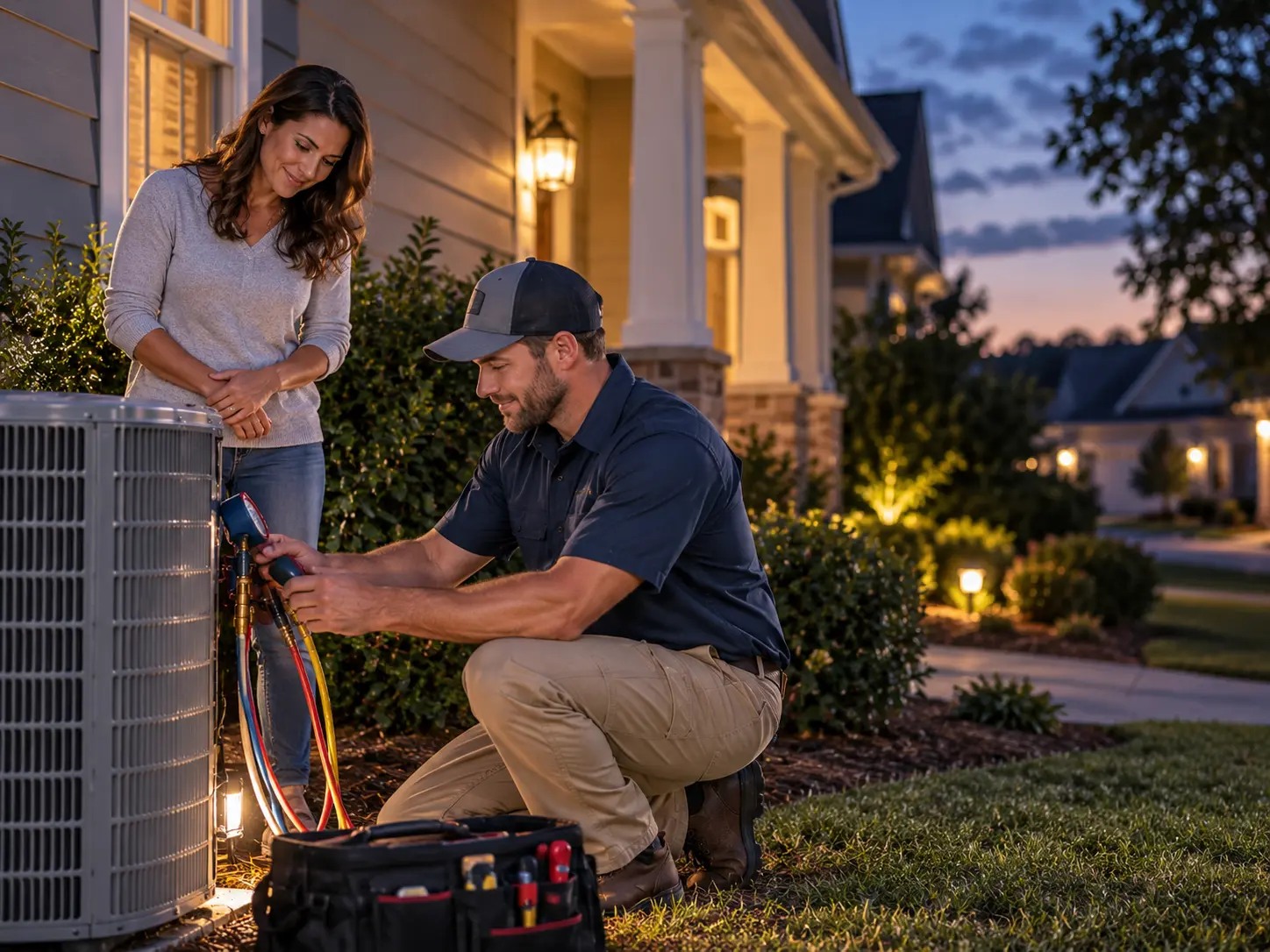
Cooling problem after normal business hours? Indoor temperatures in a closed-up Columbus home can climb into the nineties within a few hours during summer, and emergency AC repair options are available overnight.
- No cooling at all during a heat advisory
- Breaker tripping every time the system restarts
- Water actively leaking onto ceilings or flooring
- Burning smell from vents or the outdoor disconnect
- Households with infants, elderly residents, or heat-sensitive medical needs
*Service availability depends on provider participation, location, technician availability, current demand, and appointment capacity.
Decision help
Repair or Replace?
There is no universal age cutoff. What matters is the specific failure, the condition of the rest of the system, and how the home is ducted.
Repair may make sense when
- The problem is isolated to a single component
- The system is relatively young
- Repair cost is reasonable for the equipment's value
- The system otherwise cools the home well
- Major components — compressor and coils — remain healthy
Replacement may be worth discussing when
- The system is older with many accumulated run hours
- Repairs are becoming frequent season to season
- A compressor or coil failure is involved
- Cooling is uneven across the home
- Utility bills have risen significantly
- The system cannot maintain indoor comfort at peak heat
Rules of thumb circulate widely in the HVAC trade, but none of them apply universally. Read the repair vs replacement guide for the questions worth asking a contractor before deciding.
How it works
How a Home AC System Works
An air conditioner does not make cold air — it moves heat out of your house. Understanding that makes almost every symptom easier to interpret.
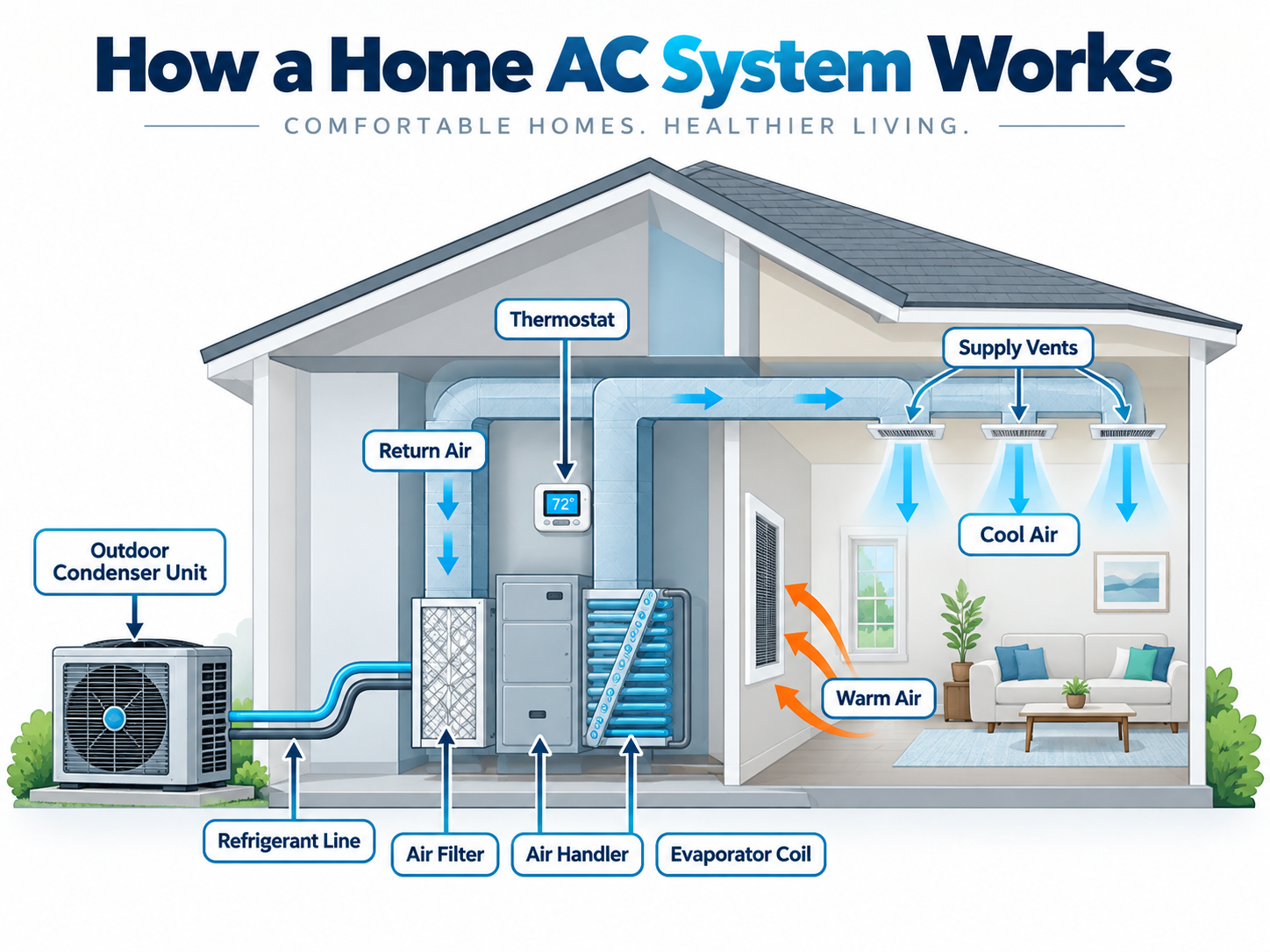
The blower pulls warm indoor air through the return and filter, then pushes it across the cold evaporator coil. Heat transfers into the refrigerant, moisture condenses onto the coil, and the cooled air travels back out through the supply vents.
Outdoors, the compressor raises the refrigerant's pressure so it becomes hotter than the Georgia air, and the condenser coil releases that heat. A metering device then drops the pressure so the refrigerant is cold again before returning indoors.
Every part of that loop depends on airflow. Restrict it indoors and the coil freezes; restrict it outdoors and pressures climb while cooling falls off.
Read the full explanationCommon causes
Common Columbus AC Problems
Six issues account for a large share of no-cooling calls in this area. Each links to a deeper explanation.
Dirty Air Filter
A clogged filter restricts airflow across the indoor coil, which lowers cooling capacity and can eventually freeze the system.
Read moreLow Refrigerant
Refrigerant is not consumed in normal operation, so a low charge means there is a leak. Cooling drops and run times climb.
Read moreFrozen Evaporator Coil
Restricted airflow or low charge lets the coil fall below freezing. Ice blocks air entirely and can damage the compressor.
Read moreClogged Condensate Drain
Humid Georgia summers produce gallons of condensate a day. A blocked line overflows the pan or trips the float switch.
Read moreDirty Condenser Coil
Pollen and grass clippings on the outdoor coil prevent heat rejection, raising pressures and reducing cooling indoors.
Read moreThermostat Problem
Dead batteries, wiring faults, or heat pump misconfiguration can stop the equipment from ever receiving a cooling call.
Read more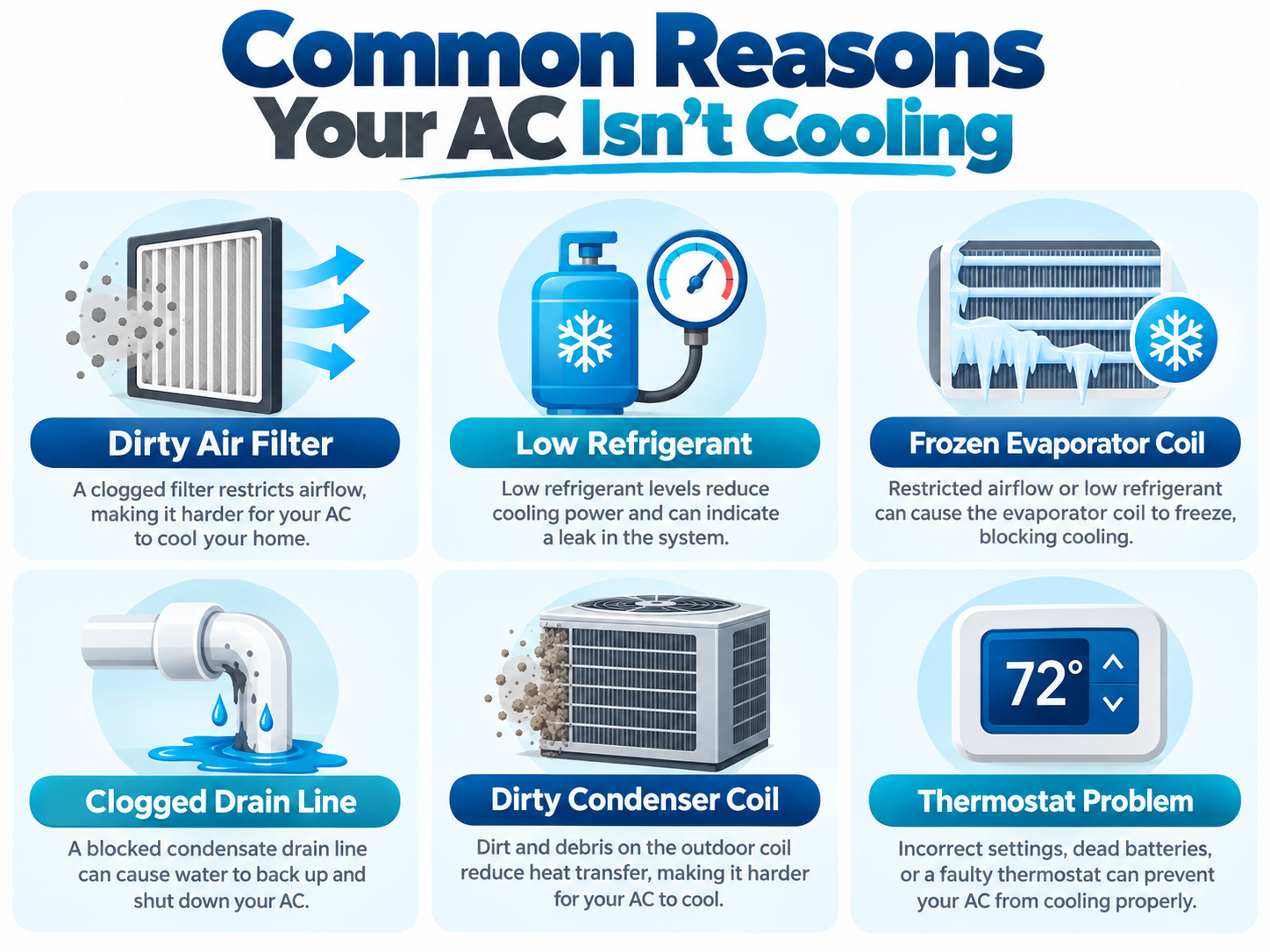
Columbus homeowners
Real AC Problems Columbus Homeowners Run Into
Columbus homeowners deal with more than just “AC not cooling.” Long hot summers, high humidity, attic heat, heavy system runtime, clogged condensate drains, and airflow problems can all affect comfort. Here are some of the most common residential cooling issues worth understanding.
House Feels Cool but Humid
Your thermostat may reach the set temperature while the house still feels sticky or uncomfortable. Poor moisture removal, short cycling, oversized equipment, airflow issues, or duct leakage may contribute.
Common signs
- Rooms feel clammy
- Windows or vents show condensation
- AC cycles frequently
Upstairs Won't Cool
Hot upper floors are common when attic heat, duct leakage, airflow imbalance, insulation problems, or thermostat placement affect the system.
Common signs
- Upstairs several degrees warmer
- Weak airflow upstairs
- AC runs for long periods
AC Runs All Day
Long runtime can be normal during extreme heat, but constant operation combined with poor cooling may indicate dirty coils, airflow problems, aging equipment, duct leakage, or other issues.
Common signs
- System rarely shuts off
- House cannot reach setpoint
- Utility bills increase
Drain Line Keeps Clogging
A condensate drain can develop slime, biofilm, debris, or other buildup that restricts water flow and may trigger safety switches or water leaks.
Common signs
- Water near the air handler
- AC unexpectedly shuts down
- Visible drain buildup
AC Making Strange Noises
Buzzing, grinding, clicking, whirring, rattling, or screeching noises can point to different mechanical or electrical problems.
Common signs
- New or sudden noises
- Noise gets louder during startup
- Outdoor or indoor fan sounds unusual
Summer Electric Bill Spiking
Heavy cooling demand, poor insulation, duct leakage, dirty HVAC components, airflow problems, aging equipment, or excessive humidity can increase energy use.
Common signs
- Bills rise sharply
- AC runs much longer
- Home still feels uncomfortable
Before you call
Things You Can Check Before Calling
These are safe for any homeowner and often identify the problem — or at least give a technician a much better starting point.
- Thermostat mode set to COOL with the fan on AUTO
- Thermostat batteries replaced if the display is dim or blank
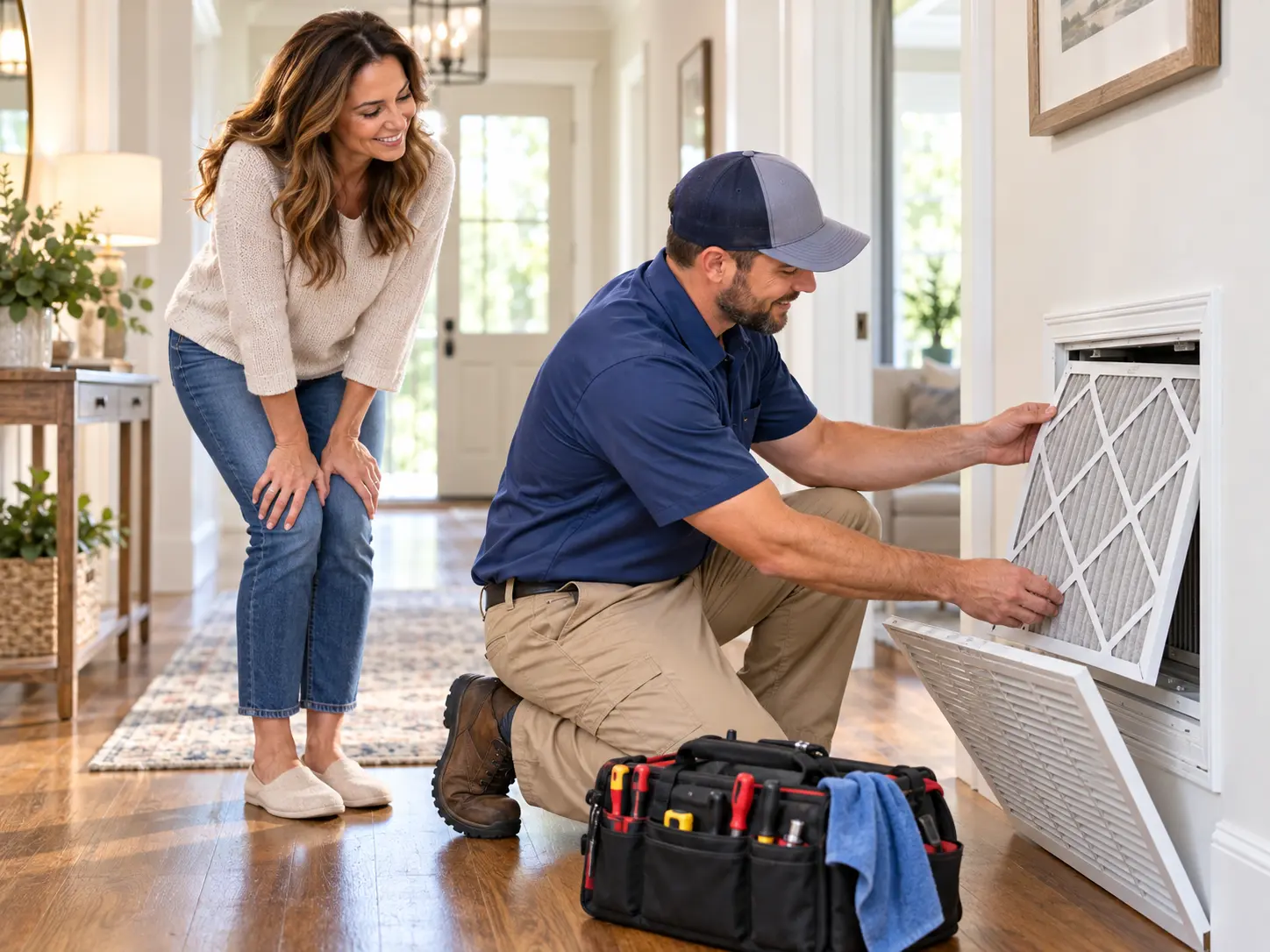
- Air filter checked and replaced if it looks loaded
- Breaker checked for both the indoor and outdoor equipment
- Return and supply vents open and unobstructed
- Outdoor unit clear of grass, pine straw and shrubs
- Drain pan checked for visible condensate backup
Safety note: Do not open electrical compartments, handle refrigerant, bypass safety devices, or attempt electrical repairs unless properly qualified.
What this site is
How This Resource Helps Columbus Homeowners
Straightforward Service Connection
One phone number and one form connect Columbus homeowners with participating local residential providers.
Residential-Focused Help
Everything here is written for homes: split systems, heat pumps, attic air handlers and household comfort problems.
Clear Problem Guidance
Each symptom page explains likely causes, safe homeowner checks, and what a professional typically measures.
24/7 Emergency Availability*
After-hours and overnight AC requests are accepted, subject to provider participation and current demand.
Local Columbus Coverage
Content and service areas are built around Columbus, Muscogee County and surrounding residential communities.
*Service availability depends on provider participation, location, technician availability, current demand, and appointment capacity.
Service area
Residential Service Areas Around Columbus
Coverage centers on Columbus and Muscogee County, extending into nearby Harris County communities and across the river to Phenix City, where availability may vary.
Homeowner guides
Helpful AC Guides and Resources
Practical explanations written for homeowners rather than contractors.
AC Not Cooling Checklist
Work through these steps in order before scheduling a repair visit.
Read moreHow a Home AC System Works
Refrigerant, airflow, and drainage explained in plain language.
Read moreWhy AC Freezes Up
Ice on a cooling coil always traces back to airflow or refrigerant.
Read moreRepair vs Replacement
A framework for weighing a major repair against new equipment.
Read moreAC Filter Change Frequency
Filter intervals for long cooling seasons, pets, and pollen.
Read moreWhy Drain Lines Clog
Condensate, algae, warm attics — and how to keep the line flowing.
Read moreColumbus AC Repair FAQs
Why is my AC running but my Columbus home isn't getting cooler?
The system is moving air without moving enough heat. Restricted airflow, a dirty indoor or outdoor coil, low refrigerant charge, or duct leakage into a hot attic are the usual reasons. Note whether the air at the vents is cool but weak, or strong but not cold — that difference points the diagnosis in very different directions.
Why does my house feel humid even though the AC is running?
Cooling and dehumidifying are two separate jobs, and a system can do the first well and the second poorly. Short cycling, oversized equipment, low airflow, a dirty evaporator coil, or humid air leaking into ductwork all reduce moisture removal while the thermostat still reads its setpoint.
Should I leave my thermostat fan on AUTO or ON during a humid Georgia summer?
If humidity is your complaint, AUTO is usually the better default. On ON the blower runs continuously, and air passing over a still-wet coil after cooling stops can carry some of that moisture back into the house, depending on the system. ON does improve room-to-room mixing, so it is a tradeoff worth testing for a week either way.
How quickly can I get AC repair in Columbus?
It depends on the time of day, current demand, and which independent providers are available. During peak summer heat, call volume across the Columbus area rises sharply. Calling 706-603-4023 and describing the symptom is the fastest way to find out what is realistically available.
Is emergency AC repair available 24/7?
Emergency availability is offered around the clock, but it is not guaranteed. Service depends on provider participation, your location, technician availability, current demand, and appointment capacity.
Why is my AC running but not cooling?
Usually restricted airflow, low refrigerant charge, or a dirty outdoor coil. All three reduce how much heat the system can remove, so it runs longer while the house slowly warms. A temperature split measurement at the air handler separates the causes quickly.
Why is my AC blowing warm air?
Warm air with the blower running usually means the outdoor unit is not operating. Common reasons are a tripped breaker, a failed run capacitor, a burned contactor, a thermostat set to the wrong mode, or a large refrigerant loss.
What causes an AC unit to freeze?
The coil drops below freezing when there is not enough warm air moving across it or not enough refrigerant flowing through it. Dirty filters, blocked returns, a dirty blower wheel, a dirty coil, and refrigerant leaks are the usual causes.
Why is water leaking around my indoor AC unit?
Most often a clogged condensate drain line causing the pan to overflow. A frozen coil melting, a cracked pan, a failed condensate pump, or improperly sloped drain piping can produce the same result.
Should I turn my AC off if it freezes?
Yes. Turn cooling off and set the fan to ON so room-temperature air thaws the coil. Running a frozen system can send liquid refrigerant back to the compressor and cause major damage.
How often should I change my AC filter in Georgia?
Standard one-inch filters generally need changing every 30 to 60 days during the cooling season, and closer to every 30 days with pets or heavy pollen. Thicker media filters last longer but should still be checked quarterly.
Why does high humidity make my house uncomfortable?
Humid air slows evaporation from your skin, so the same temperature feels warmer. Setting the thermostat fan to AUTO and allowing longer cooling cycles improves moisture removal noticeably in Georgia summers.
When should I repair versus replace an air conditioner?
Repair usually makes sense for an isolated failure on a relatively young system that otherwise cools well. Replacement is worth discussing when the system is older, repairs are becoming frequent, a compressor or coil has failed, comfort is uneven, or bills have climbed significantly.
Can thermostat problems make an AC stop cooling?
Yes. Dead batteries, a loose wire, a blown low-voltage fuse, or incorrect heat pump configuration can all prevent the cooling call from reaching the equipment even though nothing is mechanically wrong.
What should I check before calling for AC repair?
Thermostat mode and batteries, the air filter, the breaker and any service switch, open supply and return vents, clearance around the outdoor unit, and whether there is ice on the coil or water in the drain pan.
Can power outages or storms damage an AC system?
They can. Surges and brief interruptions during Columbus thunderstorms are hard on control boards, transformers, capacitors, and contactors, which is why systems often fail in the evening after a storm rather than at peak heat.
Do you service heat pumps?
Yes. Heat pumps are the most common residential system in the Columbus area, and help is available for cooling faults, changeover problems, defrost issues, and auxiliary heat concerns.
Do you provide residential AC service only?
Yes. This site focuses entirely on residential air conditioning and HVAC help for homeowners. Commercial systems are outside its scope.
Get help
Request Residential AC Service in Columbus
Call for anything urgent. For non-emergency requests, send the details and a participating provider can follow up.
Air Conditioner Repair Columbus GA
109 12th St, STE #439
Columbus, GA 31901
24/7 emergency AC availability.* Service availability depends on provider participation, location, technician availability, current demand, and appointment capacity.

Need AC Help Tonight?
Cooling problem after normal business hours? Emergency AC repair options are available for Columbus homeowners around the clock.
*Service availability depends on provider participation, location, technician availability, current demand, and appointment capacity.